If your phone isn’t ringing with new HVAC jobs, the problem usually isn’t your service it’s your visibility. Homeowners with a broken furnace or a dead AC unit don’t browse casually. They search “HVAC repair near me,” tap the first three results on Google Maps, and call. If your business isn’t in that map pack, you don’t exist to them.
That’s what local SEO for HVAC companies solves. It’s the difference between being the contractor people find in an emergency and the one they never knew existed.
This guide breaks down exactly how local SEO drives HVAC lead generation, why the same playbook works for plumbing lead generation, and how SEO for home service companies in general combined with smart contractor web design turns your website into a 24/7 lead machine.
Looking for a team to execute this for you? Start Edge Media’s SEO services build local SEO campaigns specifically for HVAC, plumbing, and other home service contractors.
Why Local SEO Matters More Than Ever for HVAC Companies ?
Search behavior for home services is almost entirely local and urgent. People searching for HVAC help are typically ready to hire within 24 hours, not “researching options for next quarter.”
Three shifts make local SEO non-negotiable in 2026:
- AI-powered search summaries. Google’s AI Overviews and tools like ChatGPT and Perplexity now answer “who’s the best HVAC company near me” directly, pulling from structured business data, reviews, and well-optimized content — not just traditional blue links.
- The Google Map Pack still wins the click. The top three local map listings capture the overwhelming majority of clicks for “near me” service searches, pushing organic results below the fold.
- Reviews now function as ranking signals and trust signals simultaneously. A contractor with 150 recent five-star reviews outranks and outconverts one with 12 reviews from three years ago, even if the second company has a nicer website.
In short: local SEO isn’t a marketing extra for HVAC companies — it’s the primary channel that determines whether you get the call or your competitor does.
The Core Pillars of Local SEO for HVAC Companies
1. Google Business Profile Optimization
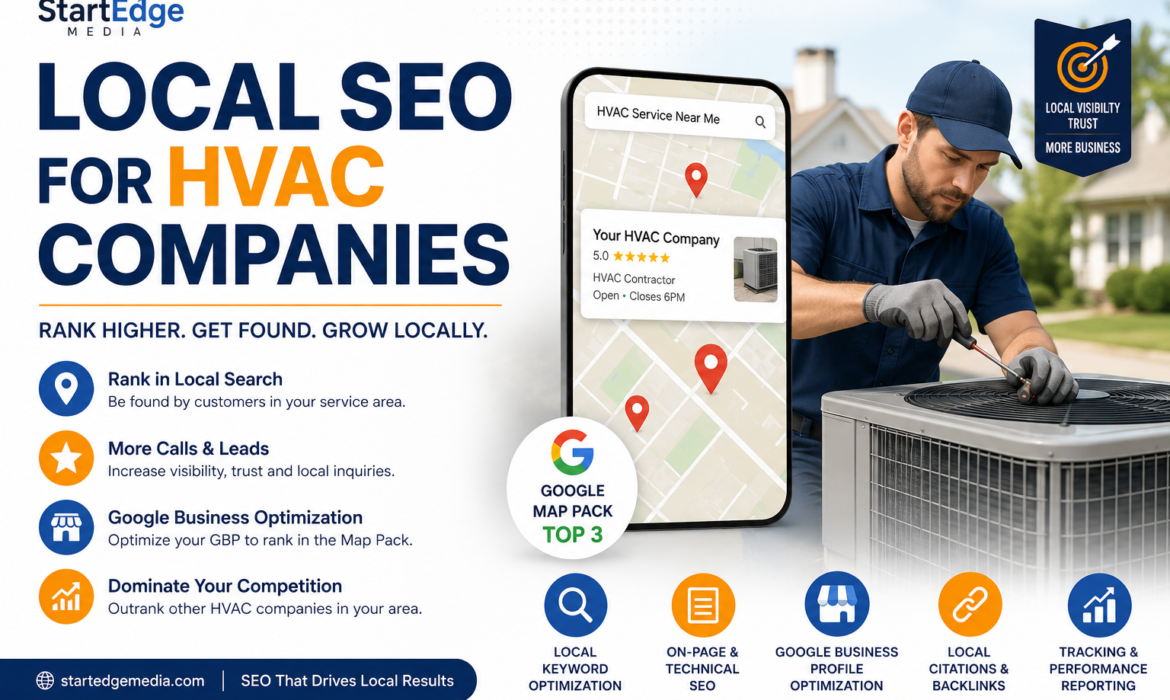
Your Google Business Profile (GBP) is the single highest-leverage local SEO asset you have. To optimize it:
- Choose accurate primary and secondary categories (e.g., “HVAC Contractor,” “Air Conditioning Repair Service,” “Furnace Repair Service”).
- List every service you offer as a distinct GBP service item, not just a general description.
- Add real job photos weekly — trucks, technicians, before/after installs.
- Post GBP updates for seasonal promotions (AC tune-ups in spring, furnace inspections in fall).
- Answer every review, positive or negative, within 24–48 hours.
2. Localized On-Page SEO
Every core service page should target a specific service plus a specific location — for example, “AC Repair in [City]” rather than a single generic “AC Repair” page trying to rank everywhere.
Best practices for on-page structure:
- One H1 per page, matching the primary keyword and location.
- Service + location combinations built into title tags, meta descriptions, and H2 subheadings.
- Embedded Google Maps and localized schema markup (LocalBusiness, Service, and FAQ schema).
- Internal links between service pages and location pages to strengthen topical relevance.
- NAP (Name, Address, Phone) consistency across the entire site and every directory listing.
3. Citations and Directory Consistency
Inconsistent business information across Yelp, Angi, HomeAdvisor, BBB, and industry-specific directories confuses both users and Google’s algorithm. A citation audit and cleanup — making sure your name, address, and phone number match exactly everywhere — is foundational, not optional.
4. Review Generation and Reputation Management
Review volume and recency are two of the strongest local ranking factors for service businesses. A simple, repeatable system — a text message sent to every customer within an hour of job completion, linking directly to your review page — will outperform sporadic manual requests every time.
5. Localized Content and Link Building
Blog content built around genuinely local topics (permit requirements, regional climate considerations, local energy rebate programs) earns links from local news sites, chambers of commerce, and community organizations — all of which strengthen your domain’s local authority.
HVAC Lead Generation: Turning Rankings Into Booked Jobs
Ranking well is only half the equation. HVAC lead generation depends on what happens after someone lands on your site or calls your number.
Fast-Loading, Mobile-First Websites
Most HVAC searches happen on a phone, often during an emergency. A site that takes more than a few seconds to load loses the visitor to the next result. Mobile speed and a prominent, always-visible click-to-call button are essential, not decorative.
Clear Calls-to-Action on Every Page
Every service page needs an obvious next step: call now, request a quote, or book online. Buried contact forms and vague “learn more” buttons quietly kill conversion rates.
Emergency Service Messaging
If you offer 24/7 emergency repair, that needs to be visible above the fold on every page, not buried in a footer. Homeowners searching at 11 p.m. with no heat are deciding in seconds.
Financing and Pricing Transparency
HVAC replacements are a major expense. Pages that mention financing options, typical price ranges, or “free estimate” language reduce hesitation and increase form submissions.
Tracking and Follow-Up
Call tracking numbers, missed-call text-back automation, and a documented follow-up sequence for quote requests can recover a significant share of leads that would otherwise go cold.
Plumbing Lead Generation Follows the Same Playbook
Plumbing lead generation mirrors HVAC almost exactly, because the buyer psychology is identical: urgent need, local search, fast decision.
The main differences worth noting:
- Plumbing searches skew even more toward true emergencies (burst pipes, sewage backups), so 24/7 messaging and immediate phone answering matter even more.
- Plumbing has more “planned” service opportunities (water heater replacement, repiping, fixture installs) that benefit from educational content and comparison-style pages.
- Seasonal patterns differ — frozen pipe searches spike in winter, while HVAC has dual peaks in summer and winter.
A contractor offering both HVAC and plumbing services should build separate, distinctly optimized service and location pages for each — never combine them into one generic “home services” page, which dilutes relevance for both.
SEO for Home Service Companies Beyond HVAC and Plumbing
The same core framework — Google Business Profile optimization, localized on-page SEO, citation consistency, review generation, and conversion-focused web design — applies across the broader home services category: electricians, roofers, landscapers, garage door companies, pest control, and appliance repair.
What changes between industries is mainly:
- Seasonality and search volume patterns
- Average job value (which affects how aggressively to invest in paid ads alongside SEO)
- The specific certifications, licenses, and trust signals that matter to that trade’s customers
SEO for home service companies works because it targets people already searching with buying intent — it’s demand capture, not demand creation. That’s why it consistently produces a stronger return on investment than most other marketing channels for local contractors.
Contractor Web Design: The Foundation Everything Else Sits On
No amount of SEO can compensate for a website that fails to convert visitors into calls. Good contractor web design for HVAC and plumbing businesses includes:
- Speed: Compressed images, minimal third-party scripts, and clean code so pages load quickly on mobile networks.
- Trust signals above the fold: Licensing info, years in business, review star ratings, and recognizable brand or association logos.
- Service-area clarity: A visible map or list of cities served, so both visitors and Google understand exactly where you operate.
- Simple navigation: Services, service areas, reviews, and contact information reachable in one or two clicks from any page.
- Structured data markup: Schema for LocalBusiness, reviews, services, and FAQs, which directly feeds both traditional search results and AI-generated answers.
A modern contractor website should be built as a lead-generation tool first and a digital brochure second.
AEO and GEO: Optimizing for AI Answer Engines, Not Just Google
Search is no longer limited to a list of blue links. Tools like Google AI Overviews, ChatGPT, and Perplexity now generate direct answers to questions like “how much does an AC installation cost” or “best HVAC company near me” often without the user ever clicking through to a website.
Answer Engine Optimization (AEO) and Generative Engine Optimization (GEO) are about making sure your business is the source AI systems pull from when generating those answers. Practical steps include:
- Writing clear, direct answers to common customer questions in plain language (like the FAQ section below), since AI systems favor concise, well-structured answers over marketing copy.
- Using FAQ schema markup so search engines and AI crawlers can easily parse question-and-answer content.
- Keeping business information (hours, service areas, pricing ranges, licensing) consistent and explicitly stated across your website, Google Business Profile, and directory listings, since AI tools cross-reference multiple sources before citing a business.
- Publishing genuinely useful, specific content rather than generic filler, since generative engines are trained to prioritize substantive, trustworthy sources.
A business that ranks well traditionally and is structured clearly for AI systems captures leads from both the old search paradigm and the new one.
A Simple Local SEO Action Plan for HVAC and Plumbing Contractors
- Audit your Google Business Profile categories, services, photos, and posting consistency.
- Fix NAP consistency across your website and top directories.
- Build or improve location + service pages for every city and core service you offer.
- Implement a review generation system that texts customers within an hour of job completion.
- Add schema markup (LocalBusiness, Service, FAQ) sitewide.
- Improve site speed and mobile conversion elements click-to-call buttons, quote forms, emergency messaging.
- Track calls and leads so you can measure what’s actually working.
Running through this list consistently, month over month, is what separates HVAC and plumbing companies that dominate local search from those that quietly lose jobs to competitors who show up first.
Ready to Turn Local Search Into Booked Jobs?
Local SEO for HVAC and plumbing companies isn’t a one-time project it’s an ongoing system of Google Business Profile management, on-page optimization, review generation, and conversion-focused web design. Done right, it becomes the most predictable, highest-ROI lead source a home service business has.
Start Edge Media’s SEO services help HVAC companies, plumbers, and other home service contractors build exactly this kind of system from technical SEO and local citations to contractor web design that actually converts.
Frequently Asked Questions
What is local SEO for HVAC companies?
Local SEO for HVAC companies is the process of optimizing a business’s Google Business Profile, website, and online listings so it ranks higher in local search results and the Google Map Pack for searches like “AC repair near me” or “furnace installation in [city].”
How long does it take to see results from HVAC SEO?
Most HVAC companies start seeing measurable improvement in local rankings and calls within 3 to 6 months, with stronger, more stable results building over 6 to 12 months as reviews, citations, and content accumulate authority.
What’s the difference between HVAC lead generation and HVAC SEO?
SEO is one channel that drives lead generation. HVAC lead generation is the broader goal getting qualified customers to call or request a quote achieved through SEO, paid ads, website conversion optimization, and reputation management working together.
Does plumbing lead generation work the same way as HVAC lead generation?
Yes, largely. Both rely on local search visibility, fast website performance, clear calls-to-action, and strong reviews. The main differences are seasonal search patterns and a heavier emphasis on true emergency messaging for plumbing.
How much should a home service company budget for SEO?
Budgets vary by market size and competition, but most home service companies invest a consistent monthly amount into SEO rather than a one-time project, since local rankings and lead flow are maintained through ongoing optimization, content, and review generation.
Why does my contractor website get traffic but no calls?
This usually points to a web design or conversion problem rather than an SEO problem — slow load times, buried contact information, no clear calls-to-action, or a lack of trust signals like reviews and licensing information near the top of the page.
What is AEO and GEO, and why does it matter for contractors?
AEO (Answer Engine Optimization) and GEO (Generative Engine Optimization) refer to optimizing content so AI tools like Google AI Overviews, ChatGPT, and Perplexity can understand and cite your business when generating direct answers to customer questions, in addition to ranking in traditional search results.
Do I need a new website, or can my current site be optimized?
Many contractor websites can be improved through better site speed, clearer calls-to-action, schema markup, and localized page structure without a full rebuild. A full redesign is usually only necessary if the site is outdated, slow, or not mobile-friendly.