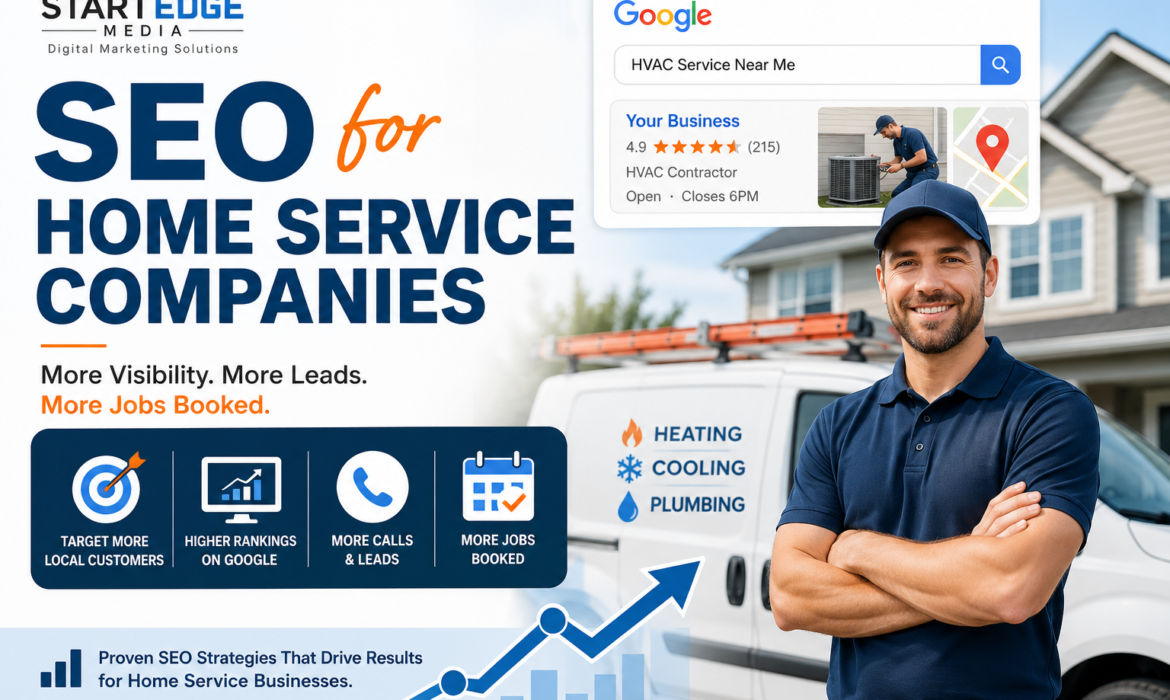
Quick answer: SEO for home service companies is the process of optimizing a contractor’s website, Google Business Profile, and local citations so the business ranks higher in Google search and Google Maps results for terms like “plumber near me” or “HVAC repair [city].” For plumbing, HVAC, electrical, and other home service businesses, strong SEO combined with conversion-focused contractor web design is one of the most reliable ways to generate consistent, low-cost leads month after month without depending entirely on paid ads.
This guide breaks down exactly what it takes to build an SEO strategy that turns searches into service calls, including contractor web design best practices, local SEO for HVAC companies, and proven HVAC and plumbing lead generation tactics.
Why SEO for Home Service Companies Is Different From Other Industries
Home service businesses plumbers, HVAC contractors, electricians, roofers, and remodelers sell local, urgent, high-intent services. Someone searching “emergency AC repair near me” isn’t researching; they want a company on the phone in minutes. That changes how SEO should be approached:
- Local intent dominates. Most searches include a location or “near me,” so ranking in the local map pack matters as much as ranking organically.
- Trust decides the click. Reviews, licensing, and years in business influence conversions more than they do in most other industries.
- Speed of contact wins the job. A site that isn’t built to convert a visitor into a phone call or form submission wastes the traffic SEO brings in.
Because of this, effective SEO for home service companies always pairs technical and local SEO work with contractor web design that’s built to convert.
Contractor Web Design: The Foundation Every SEO Strategy Needs
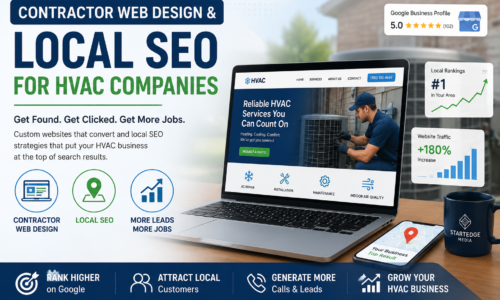
Ranking a website that doesn’t convert is a wasted budget. Contractor web design should be treated as part of the SEO strategy, not a separate project, because Google’s ranking systems and AI-driven search results both reward sites that are fast, mobile-friendly, and easy for users to act on.
Core elements of high-converting contractor web design:
- Click-to-call buttons and sticky phone numbers visible on every page, especially on mobile
- Service-specific landing pages (e.g., “Water Heater Repair,” “AC Installation,” “Drain Cleaning”) instead of one generic services page
- Location pages for every city or service area, each with unique, locally relevant content
- Fast load times — home service visitors searching on mobile during an emergency won’t wait for a slow site
- Trust signals above the fold: licensing info, years in business, star ratings, and financing or guarantee badges
- Simple, short contact forms with minimal required fields
- Before/after project photos and video to build credibility for larger jobs like remodels or system installs
A well-structured, fast, mobile-optimized website also gives search engines and AI answer engines clean signals about what the business does and where it operates — which directly supports the local SEO work described below.
Local SEO for HVAC Companies: Winning the Map Pack
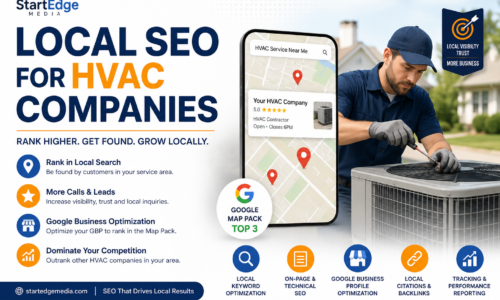
Local SEO for HVAC companies focuses on getting a business into the top 3 results of the Google Map Pack — the local results shown above organic listings for searches like “HVAC contractor near me” or “furnace repair [city].” Since most people never scroll past the map pack, this is often the highest-value real estate in local search.
Key components of local SEO for HVAC companies:
- Google Business Profile optimization — accurate categories, service areas, business hours, photos, and regular posts/updates
- NAP consistency — Name, Address, Phone number must match exactly across the website, directories, and citations
- Local citations — listings on directories like Angi, HomeAdvisor, Yelp, BBB, and industry-specific directories
- Review generation and management — a steady flow of recent, keyword-rich reviews mentioning services like “AC installation” or “heat pump repair”
- Localized on-page content — service pages and blog content that reference specific neighborhoods, cities, and local climate considerations
- Local schema markup — structured data that tells search engines (and AI tools) exactly what services are offered and where
This same framework applies well beyond HVAC — plumbing, electrical, roofing, and general contracting companies all benefit from the same local SEO playbook.
HVAC Lead Generation: Turning Rankings Into Booked Jobs
Ranking is only step one. HVAC lead generation is about converting that visibility into actual calls, form fills, and booked appointments.
Proven HVAC lead generation strategies:
- Seasonal content targeting — publishing and updating pages around AC tune-ups in spring, furnace maintenance in fall, and emergency repair content year-round
- Service + location keyword pages — pages built for combinations like “furnace installation [city]” that match how people actually search
- Call tracking — using dedicated tracking numbers to measure exactly which pages and keywords generate calls
- Financing and maintenance plan offers — content and landing pages that address the biggest objection for large HVAC purchases: cost
- Retargeting and email follow-up for visitors who didn’t convert on the first visit
- Answering “near me” and voice search queries directly, since a growing share of HVAC searches now come through voice assistants and AI search tools
Plumbing Lead Generation: Capturing High-Intent, Urgent Searches
Plumbing lead generation shares many tactics with HVAC but leans even more heavily on urgency, since a large share of plumbing searches (burst pipes, clogged drains, no hot water) are emergencies.
Effective plumbing lead generation tactics:
- Emergency service pages optimized for “24 hour plumber [city]” and similar urgent-intent searches
- FAQ-style content answering common plumbing questions directly, which also improves visibility in AI-generated answers (see the GEO section below)
- Google Local Services Ads (LSAs) paired with organic SEO to capture both the paid and organic sections of the results page
- Review velocity — plumbing customers are especially influenced by recent, specific reviews (“fixed my burst pipe within an hour”)
- Streamlined mobile booking — since emergency plumbing searches happen almost entirely on mobile devices
Answer Engine Optimization (AEO): Getting Featured in Direct Answers
Search is no longer just ten blue links. Google’s AI Overviews, featured snippets, and voice assistants now answer many “near me” and “how much does X cost” queries directly. Answer Engine Optimization (AEO) is the practice of structuring content so these systems can pull it out as a direct answer.
How home service companies can optimize for AEO:
- Open each key section with a direct, concise answer (as this guide does) before expanding into detail
- Use clear question-based subheadings that match real search queries
- Add FAQ sections with structured, scannable answers (see below)
- Use schema markup (FAQPage, LocalBusiness, Service) so search engines can parse content programmatically
- Keep answers factual and specific — include real numbers, service areas, and timeframes rather than vague marketing language
Generative Engine Optimization (GEO): Getting Cited by AI Tools
Generative Engine Optimization (GEO) extends AEO further — it’s about making sure a home service company’s content gets referenced and cited by AI tools like ChatGPT, Google AI Overviews, and Perplexity when users ask things like “best way to find a reliable HVAC contractor” or “how much does drain cleaning cost.”
GEO best practices for contractors:
- Publish original, specific data (average job costs, response times, service area coverage) — AI systems favor concrete, citable facts over generic claims
- Maintain consistent business information across the website, Google Business Profile, and directories, since AI tools cross-reference multiple sources
- Structure content with clear headings, lists, and definitions that are easy for language models to extract and summarize
- Build genuine topical authority with in-depth service and location pages rather than thin, duplicate content
- Earn mentions and citations from reputable local and industry sources, since AI systems weight third-party validation heavily
Together, strong technical SEO, AEO, and GEO make sure a home service company shows up whether a customer is scrolling a traditional search results page or asking an AI assistant for a recommendation.
Building a Complete SEO Strategy for Home Service Companies
A results-driven approach typically combines:
- Technical SEO — site speed, mobile usability, indexing, and clean site architecture
- Contractor web design built around conversions, not just aesthetics
- Local SEO — Google Business Profile, citations, reviews, and location pages
- Content strategy — service pages, location pages, and FAQ content optimized for both traditional search and AI answer engines
- Lead tracking — call tracking and analytics to know exactly which efforts are generating booked jobs, not just traffic
This is the same integrated approach used by agencies specializing in the space — combining SEO, web design, and local optimization into one strategy focused on measurable lead volume rather than rankings alone.
FAQs
What is SEO for home service companies?
SEO for home service companies is the process of optimizing a contractor’s website, Google Business Profile, and online listings so the business appears higher in local search results for services like plumbing, HVAC, and electrical work — driving more calls and booked jobs from people actively searching for those services.
How is contractor web design different from a regular business website?
Contractor web design prioritizes fast load times, mobile usability, click-to-call functionality, service and location-specific pages, and visible trust signals like licensing and reviews — all built to convert urgent, local searches into phone calls rather than just present information.
How long does local SEO for HVAC companies take to show results?
Most HVAC companies start seeing measurable improvement in local rankings and lead volume within 3 to 6 months, though this varies based on competition in the local market, the current state of the website, and the consistency of citations and reviews.
What’s the difference between HVAC lead generation and general SEO?
General SEO focuses on rankings and traffic, while HVAC lead generation focuses specifically on converting that traffic into calls, form submissions, and booked appointments through targeted landing pages, call tracking, and conversion-focused design.
Is plumbing lead generation only about SEO?
No. Effective plumbing lead generation typically combines organic local SEO with Google Local Services Ads, review generation, and mobile-optimized booking, since many plumbing searches are emergencies where multiple visibility channels increase the chance of getting the call.
What is AEO (Answer Engine Optimization) and why does it matter for contractors?
AEO is the practice of structuring website content so search engines and voice assistants can pull direct answers from it — such as pricing ranges or service details — increasing a contractor’s chances of appearing in featured snippets and voice search results.
What is GEO (Generative Engine Optimization)?
GEO is the practice of optimizing content so AI tools like ChatGPT, Google AI Overviews, and Perplexity are more likely to reference or cite a business when answering user questions, using clear structure, specific facts, and consistent business information across the web.
Do I need both SEO and a new website to generate more leads?
Not always, but SEO performs best when paired with a website designed to convert — ranking higher only helps if the site can turn that traffic into calls and booked appointments once visitors arrive.