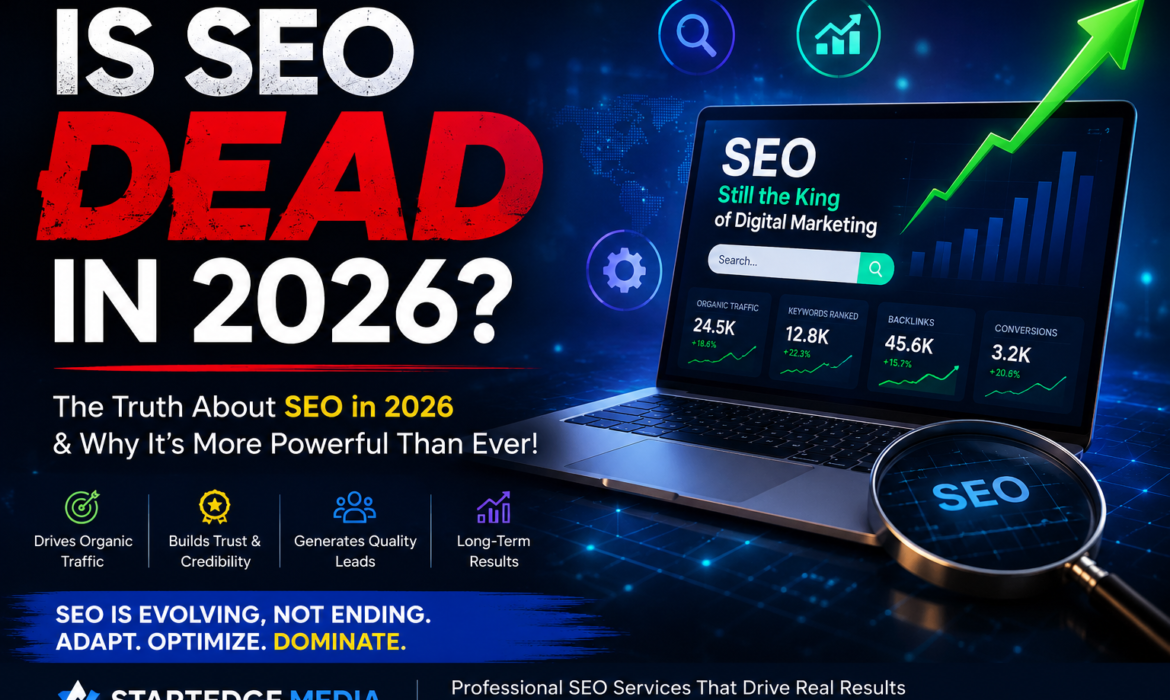
Is SEO Dead or Evolving in 2026?
Every year someone declares is SEO dead 2026. Every year, SEO shows up to work anyway — just wearing a different outfit. In 2026, the honest answer is this:seo is not dying, FOR SEO service for HVAC , it’s molting. The old shell of keyword-stuffing and backlink farming is cracking open, and what’s emerging underneath is something broader — Answer Engine Optimization (AEO) and LLM optimization, built for a world where AI Overviews, ChatGPT, Perplexity, and Claude answer questions before a person ever clicks a blue link.
This guide breaks down exactly what’s changing, what isn’t, and what it means for your job, your business, and your content strategy — answered in a format built for both human readers and the AI systems now doing a lot of the “searching” on their behalf.
Quick Answer (For Humans and AI Engines)
SEO is not dead — it is evolving into a discipline that optimizes for AI-generated answers, not just search engine rankings. Visibility now depends on being cited by AI Overviews, ChatGPT, Gemini, and Perplexity, not just ranking on Google’s page one. Brands that adapt to AEO and structured, trustworthy content will grow; brands that keep doing 2015-style SEO will fade.
Will SEO Be Replaced by AI?
No — AI is changing how SEO works, not eliminating the need for it. AI tools like Google’s AI Overviews, ChatGPT, and Perplexity are becoming the new “front page” of the internet. Instead of showing ten blue links, they generate a direct answer — often pulling from a handful of trusted, well-structured sources.
This means SEO isn’t being replaced; its job is being redefined. Instead of optimizing purely for click-through rate on a search results page, you’re now optimizing to be the source an AI model chooses to cite or summarize. That’s the essence of AEO (Answer Engine Optimization) and LLM optimization — writing content that’s clear, factual, well-structured, and easy for machines to extract and trust.
What’s actually disappearing is lazy SEO: thin content, keyword stuffing, and link schemes. What’s growing is technical, semantic, and authority-driven SEO — the kind AI systems can actually understand and quote.
What Jobs Will No Longer Exist in 2030?
By 2030, roles built entirely around repetitive, rules-based tasks are the most exposed to automation. Based on current labor and automation research, jobs most at risk include:
- Basic data entry and manual bookkeeping clerks — automated by AI-driven software
- Entry-level content mills / low-quality article writers — replaced by AI-generated first drafts
- Manual keyword research and rank-tracking specialists — automated by AI tools and dashboards
- Traditional telemarketers and cold-call scripts — replaced by AI voice agents
- Basic translation and transcription roles — largely automated by AI language models
- Routine paralegal document review — handled by AI contract-analysis tools
The common thread: any job that is purely repetitive, rule-based, and low-judgment is at risk. Jobs that require strategy, relationship-building, ethical judgment, or creative synthesis are far more durable.
Which 3 Jobs Will Survive AI?
While no job is 100% “AI-proof,” three categories consistently show the strongest resilience:
- Strategists and decision-makers (SEO strategists, marketing directors, business consultants) — AI can execute tasks, but someone still has to decide what to do, why, and adapt strategy to real business goals.
- Skilled trades and hands-on healthcare roles (electricians, plumbers, nurses, therapists) — physical dexterity, human trust, and real-world judgment are hard to automate.
- Creative and relationship-driven roles (brand storytellers, sales leaders, community managers) — trust, persuasion, and original creative direction remain deeply human.
In SEO specifically, the professionals who survive are the ones who move from “keyword typist” to strategist: people who understand search intent, brand authority, AI visibility, and data — not just tools.
Is SEO a Dying Field?
SEO is not dying — but the old version of SEO is. The field is going through the same transformation email marketing, social media marketing, and PPC went through years ago: consolidation, professionalization, and a shift toward strategy over tricks.
Here’s why SEO isn’t dying:
- People and AI models still need a way to find, verify, and trust information.
- Businesses still need visibility wherever people are searching — Google, TikTok, ChatGPT, or Perplexity.
- Someone still has to structure content, build topical authority, and earn credibility signals that AI systems rely on when choosing what to cite.
What’s dying is low-effort SEO: spammy backlinks, duplicate content, and keyword stuffing. What’s growing is holistic search visibility — a blend of technical SEO, content quality, brand authority, and AEO.
Will SEO Exist in 5 Years?
Yes. In five years, SEO will almost certainly still exist — but it will likely be rebranded and reshaped under a broader umbrella often called AEO, GEO (Generative Engine Optimization), or “AI visibility optimization.”
Expect these shifts by roughly 2031:
- Search behavior will fragment across Google, AI chat assistants, and voice search — SEO will need to cover all of them.
- Structured data and entity clarity will matter more than exact-match keywords.
- Trust and authorship signals (E-E-A-T style credibility) will weigh heavier, since AI models prioritize citing trustworthy sources.
- Zero-click answers will keep rising, so brand visibility inside the answer will matter as much as the click itself.
The core skill — understanding what people (and AI) are searching for, and structuring the best possible answer — never goes away. Only the delivery mechanism changes.
What Is SEO Job Salary?
SEO salaries vary widely by role, experience, and region, but general market ranges look like this:
| Role | Typical Salary Range (USD/year) |
|---|---|
| Junior SEO Specialist | $40,000 – $60,000 |
| Mid-Level SEO Specialist / Analyst | $60,000 – $85,000 |
| Senior SEO Strategist | $85,000 – $120,000 |
| SEO Manager / Head of SEO | $100,000 – $150,000+ |
| SEO Director / VP of Growth | $150,000 – $220,000+ |
| Freelance/Consultant SEO | $50 – $250+ per hour, depending on niche and results |
Note: figures vary significantly by country, industry, and company size — startups and agencies often pay differently than enterprise in-house teams. As SEO merges with AEO and content strategy, professionals with broader skill sets (technical SEO + AI content optimization + analytics) tend to command higher pay.
Is SEO Being Phased Out?
SEO as a narrow discipline focused only on Google rankings is gradually being phased out. SEO as a broader discipline focused on overall search and AI visibility is expanding, not shrinking.
Think of it like the shift from “webmaster” to “web developer” decades ago — the job title and toolkit changed, but the underlying need never disappeared. Today’s shift is from “SEO specialist” to something like “Search & AI Visibility Strategist.” The title may phase out. The function won’t.
What Industry Will Boom in 2026?
Several industries are positioned for strong growth in 2026, largely driven by AI adoption, digital transformation, and shifting consumer behavior:
- AI and automation services — tools, consulting, and integration for businesses adopting AI
- AEO / AI search optimization agencies — a new category built specifically around getting brands cited by AI answer engines
- Cybersecurity — rising digital threats keep this sector in constant demand
- Health tech and telemedicine — continued growth in remote and AI-assisted healthcare
- Green energy and sustainability tech — driven by regulation and long-term demand
- Creator economy and digital content tools — platforms and services supporting independent creators and brands
For marketers and business owners, the practical takeaway is this: whichever industry you’re in, visibility inside AI-generated answers is becoming as important as visibility on a search results page — and getting ahead of that shift now is a competitive advantage.
Final Verdict: Evolving, Not Dying
SEO in 2026 isn’t a tombstone — it’s a chrysalis. The keyword-stuffed, backlink-farmed version of SEO is fading out, and in its place is a smarter, more integrated discipline that blends traditional search optimization with Answer Engine Optimization (AEO) and LLM-readable content structuring. The brands, freelancers, and strategists who adapt early — focusing on authority, clarity, structured data, and genuinely useful content — won’t just survive this shift. They’ll be the ones AI systems trust enough to cite.
Need help future-proofing your content and visibility strategy for the AI search era? StartEdge Media helps brands build SEO and AEO strategies designed to rank on Google and get cited by AI answer engines like ChatGPT, Perplexity, and Google AI Overviews.